

An exceptionally interesting denarius of Marcus Junius Brutus, carrying extraordinary historical significance and struck approximately ten years before the assassination of Julius Caesar. As early as 54 BC, the future participant in the conspiracy of the Ides of March referred on his coinage to two themes that would later become inseparably associated with his name: the liberty of the Republic and his family’s tradition of opposition to monarchical rule.
The issuer of the denarius was Marcus Junius Brutus, who at the time was still at a relatively early stage of his political career. He used the opportunity to select the coin’s iconography to evoke the traditions and ancestry of his own family.
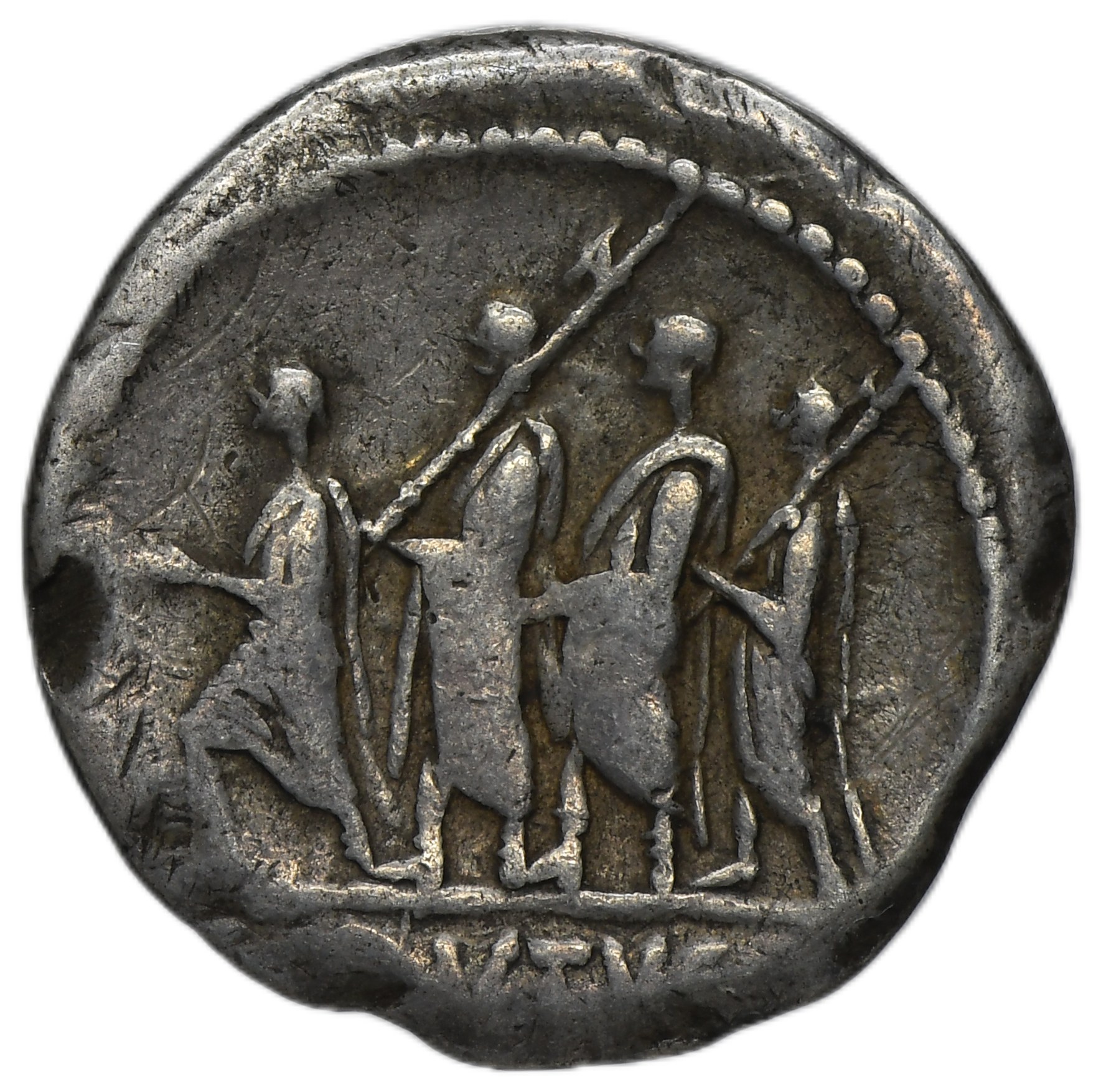
The central figure of the composition, however, is not the issuer himself, but his celebrated presumed ancestor, Lucius Junius Brutus, whom Roman tradition regarded as one of the principal figures responsible for the overthrow of the monarchy and the establishment of the Republic at the end of the 6th century BC. According to the traditional chronology, following the expulsion of the last king, Tarquinius Superbus, Lucius Junius Brutus became one of the first consuls of the Republic in 509 BC.
The reverse is not merely a portrait of an ancestor. Brutus is shown in a ceremonial magistrate’s procession, walking between two lictors carrying fasces and preceded by an accensus, an attendant of a Roman magistrate. The scene evoked his consular dignity while simultaneously serving as a visual reminder of the beginnings of the Republican political order. In the exergue appears a single, exceptionally evocative word: BRVTVS.
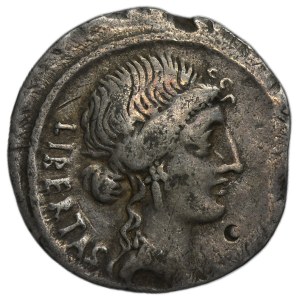
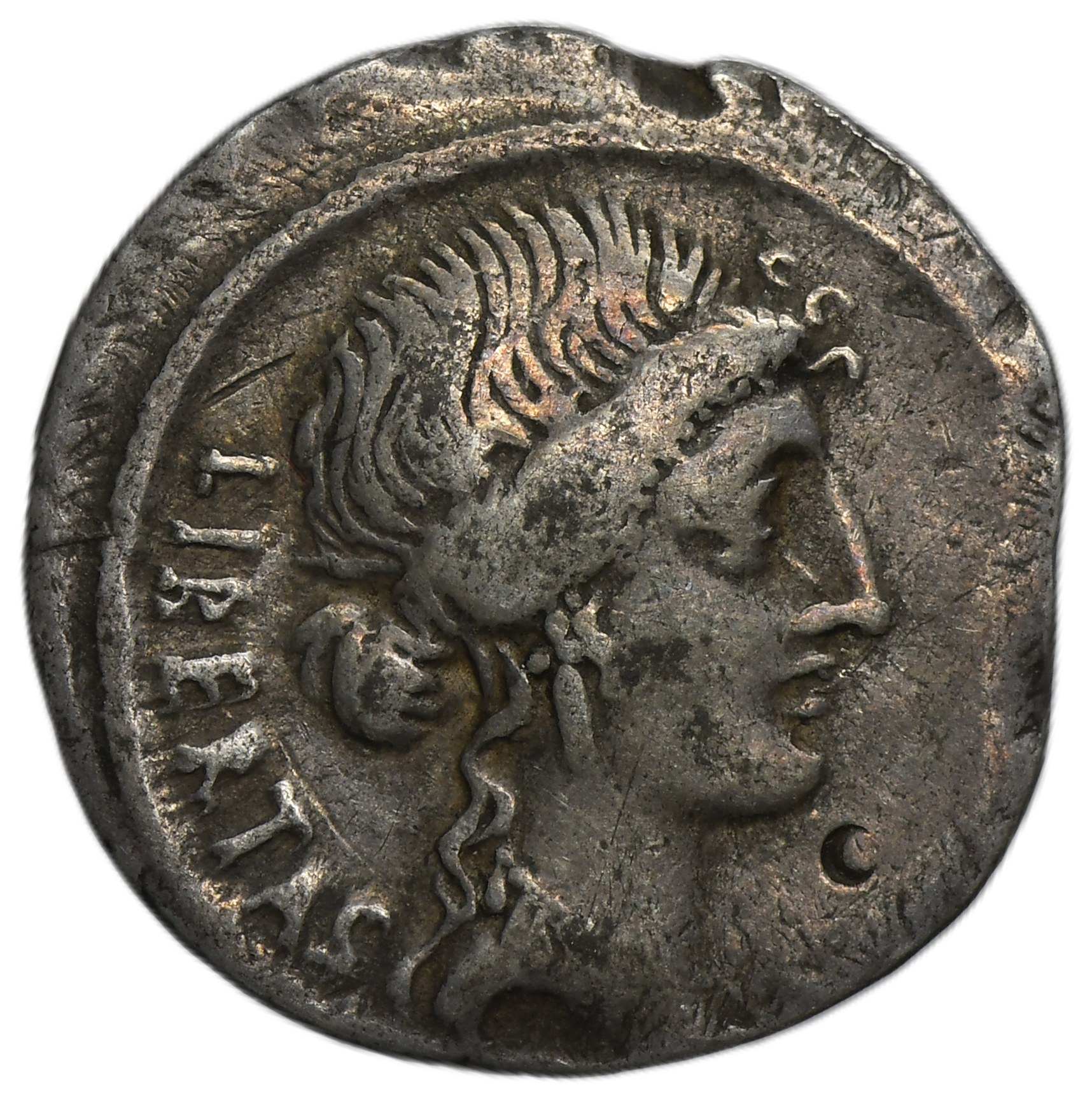
The significance of the reverse becomes even clearer when considered alongside the obverse. It depicts the personification of Libertas, Liberty, whose name appears beside her head. This is therefore far more than a generic representation of a Roman personification. The combination of Libertas and Lucius Junius Brutus creates a coherent iconographic programme: the liberty of the Roman people is juxtaposed with the man whom tradition credited with helping to overthrow the monarchy and establish the Republic.
The coin possesses another particularly fascinating dimension. During the same period, Brutus issued a second denarius (Crawford 433/2) depicting Lucius Junius Brutus and Gaius Servilius Ahala. In Roman tradition, both men were regarded as archetypal defenders of the Republican order against individuals seeking excessive personal power. The two types should therefore be understood as elements of a deliberate genealogical and political programme promoted by the young Brutus.
The denarius naturally acquires particular significance in light of the events that followed ten years later. On 15 March 44 BC, Marcus Junius Brutus became one of the leading participants in the conspiracy that resulted in the assassination of Julius Caesar. The conspirators presented their actions as a defence of the Republic against tyranny, while Brutus could invoke a family tradition associated with the man credited with expelling Rome’s last king.
Caution is nevertheless required when interpreting a coin struck in 54 BC exclusively through the prism of Caesar’s later assassination. At the time of its issue, Caesar’s dictatorship and the Ides of March still lay in the future. What the denarius does demonstrate, however, is that the themes of libertas and the Republican tradition associated with the name of Brutus formed part of his public image long before the events of 44 BC.
For this reason, the present type ranks among the most fascinating issues of the final decades of the Roman Republic. Ten years before the Ides of March, Brutus placed Liberty on one side of his coin and, on the other, the man whom Roman tradition had transformed into a symbol of the overthrow of monarchy. The issuer’s subsequent fate endowed this combination with a significance that its original audience in 54 BC could not yet have fully anticipated.
It is also worth noting the remarkable longevity of this imagery. The type was regarded as sufficiently important to Roman history that more than a century and a half later it was reproduced as part of Emperor Trajan’s restitution coinage.
Roman Republic
Marcus Iunius Brutus (54 BC), Denarius 54 BC, mint Rome
Obverse: head of Libertas right
LIBERTAS
Reverse: L. Junius Brutus walking left, between two lictors carrying fasces and preceded by an accensus
BRVTVS
Diameter 19 mm, weight 3.64 g